
Pileated woodpecker damage

Cause and general information
The pileated woodpecker (Dryocopus pileatus L.) is a large black and white bird crested with striking red feathers on its head. It feeds on carpenter ants and wood-boring beetles and can be quite destructive to trees when it chips away large holes in search of its food. However, its feeding damage is an indication of insect infestation and decay, and it does not excavate holes in healthy, sound trees.
Distribution and species affected
Pileated woodpeckers can be found year-round in forested areas of Canada ranging from the west to east coasts, with a northern limit coinciding with the closed-canopy forests of the southern boreal zone (that is, well south of the tree line). In the United States, their distribution range extends south in forested areas in narrow bands along the Pacific Coast and into northern Idaho, and throughout the eastern states from the Great Lakes and extending south to the Gulf of Mexico. They prefer mature stands of trees either in mixed or coniferous forests, or younger forests that also contain scattered, large dead trees. Trees chosen for feeding are infested with beetles or carpenter ants, and are usually old-growth or dead, measuring at least 25 centimetres (but preferably greater than 40 centimetres) in diameter at breast height (1.3 metres above the ground). Trees chosen for nesting or roosting almost always have previously established wood decay columns caused by conk-producing polypore fungal genera such as Fomitopsis, Ganoderma, Porodaedalea, Phellinus, and others. The softening of the wood caused by the decay makes excavation of large cavities possible. However, trees infected by these fungi generally do not develop the long, extensive decay columns required for nesting and roosting (greater or equal to 1 metre long) until they are well older than 100 years.
Tree parts affected
Trunks of large trees, both conifers and broadleaf
Symptoms and signs
Pileated woodpeckers are larger birds with a stout bill and distinctive colouration. They are about 40 to 49 centimetres long with a wingspan of 60 to 75 centimetres. They are mostly black with white stripes on the head and a bright red crest. The undersides of the wings are mostly white in flight. Males have a red stripe on the cheek.
Pileated woodpeckers feed on dead and decaying trees infested with beetles and carpenter ants. They excavate multiple large square to rectangular holes or long trough-like furrows (sometimes measuring over 1 metre in length) in exposed wood of dead or living trees with advanced decay and infested with insects. They produce large piles of thumb-length wood chips at the base of the excavated tree. The furrows are caused by the birds excavating out carpenter ant nests. The feeding cavities are usually surrounded by a perimeter of bare sapwood spanning a few centimetres wide, which contrasts with the darker intact bark. Feeding cavities can be distinguished from nesting and roosting cavities by their shape (irregular and varied), shallow depth (extending only 5 to 20 centimetres into the wood), and openings that appear lighter in colour (due to their shallow depth). Nesting holes are round- or teardrop-shaped, about 9 centimetres wide and 12 centimetres tall, and lead to a cavity that may reach 0.75 metres in depth. There is usually only one nesting hole per tree. Roosting holes are oval-shaped, range from 7.5 to 10 centimetres wide and 10 to 12.5 centimetres high, and lead to cavities that may reach an astonishing 4.5 metres in length. There are often multiple entrance holes per roosting cavity.
Damage
In urban or park settings where pileated woodpecker activity is noticed, a damaged tree is an indication that it could be prone to failure due to decay or insect damage, and it should be assessed for soundness and possible removal.
Prevention and management
No prevention is warranted. Many other bird and mammal species depend on cavities created by woodpeckers for nesting and shelter. However, in managed second-growth conifer forests, the rotation of the stand (from establishment to harvest) might be shorter than the time required for trees to develop heart rot columns big enough to provide habitat for woodpeckers. To maintain woodpecker populations, wildlife managers may resort to creating artificial cavities in trees by intentionally wounding the upper trunk and/or inoculating them with wood decay fungi.
Although pileated woodpeckers can be found year-round, they are protected by the Migratory Birds Convention Act in Canada, so no measures should ever be taken to harm these birds.
Information on legal protection of migratory birds can be found at https://www.canada.ca/en/environment-climate-change/services/migratory-birds-legal-protection/overview.html.
Information on the protected status of pileated woodpeckers can be found at https://www.canada.ca/en/environment-climate-change/services/migratory-birds-legal-protection/list.html.
Photos

Pileated woodpecker (Dryocopus pileatus) searching for insects.
iStock.com/BrianLasenby

A pair of juvenile pileated woodpeckers (Dryocopus pileatus) in tree cavity nest.
iStock.com/robert brown
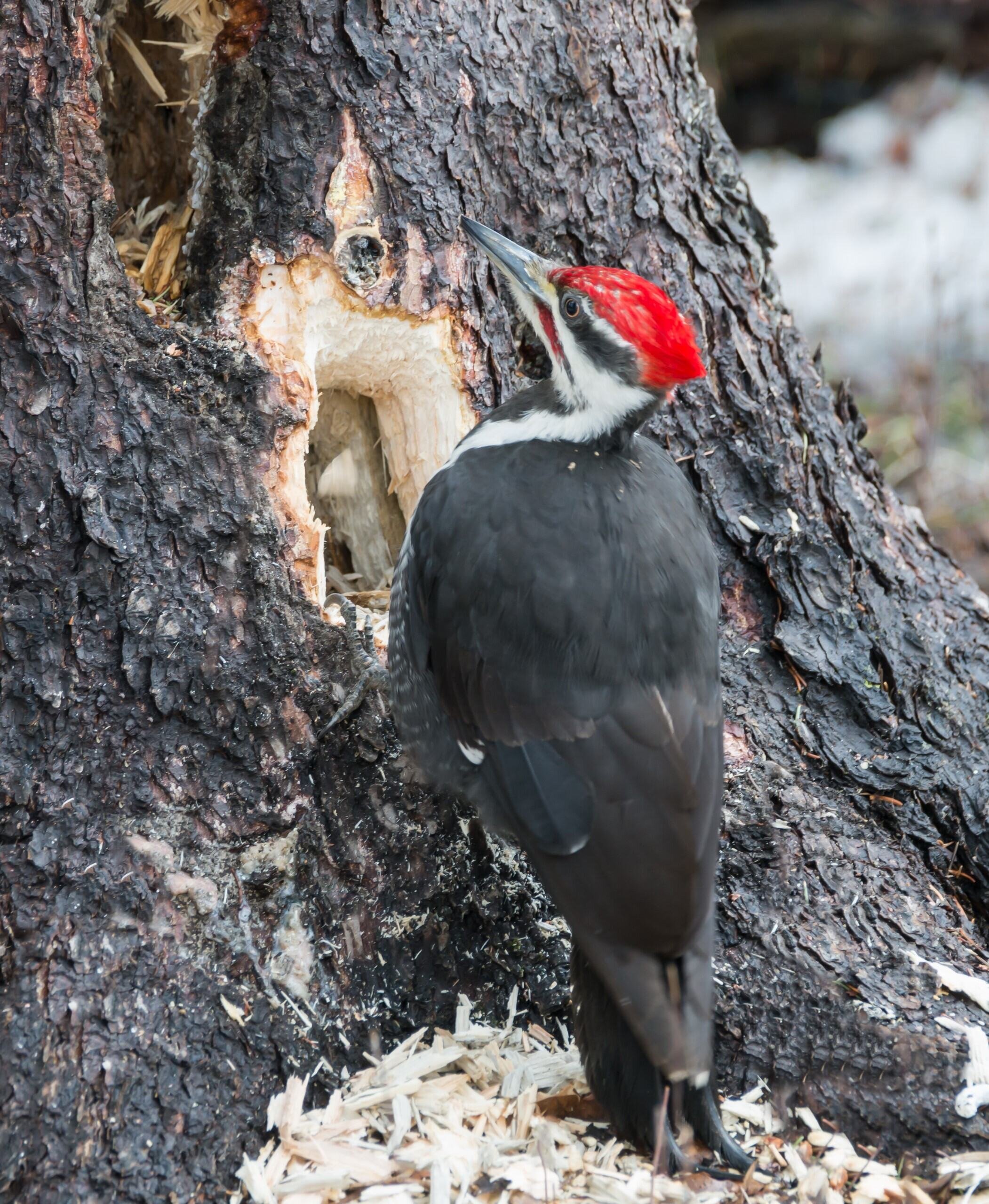
Male pileated woodpecker (Dryocopus pileatus) searching for insects. Ottawa, Ontario Canada
iStock.com/impr2003
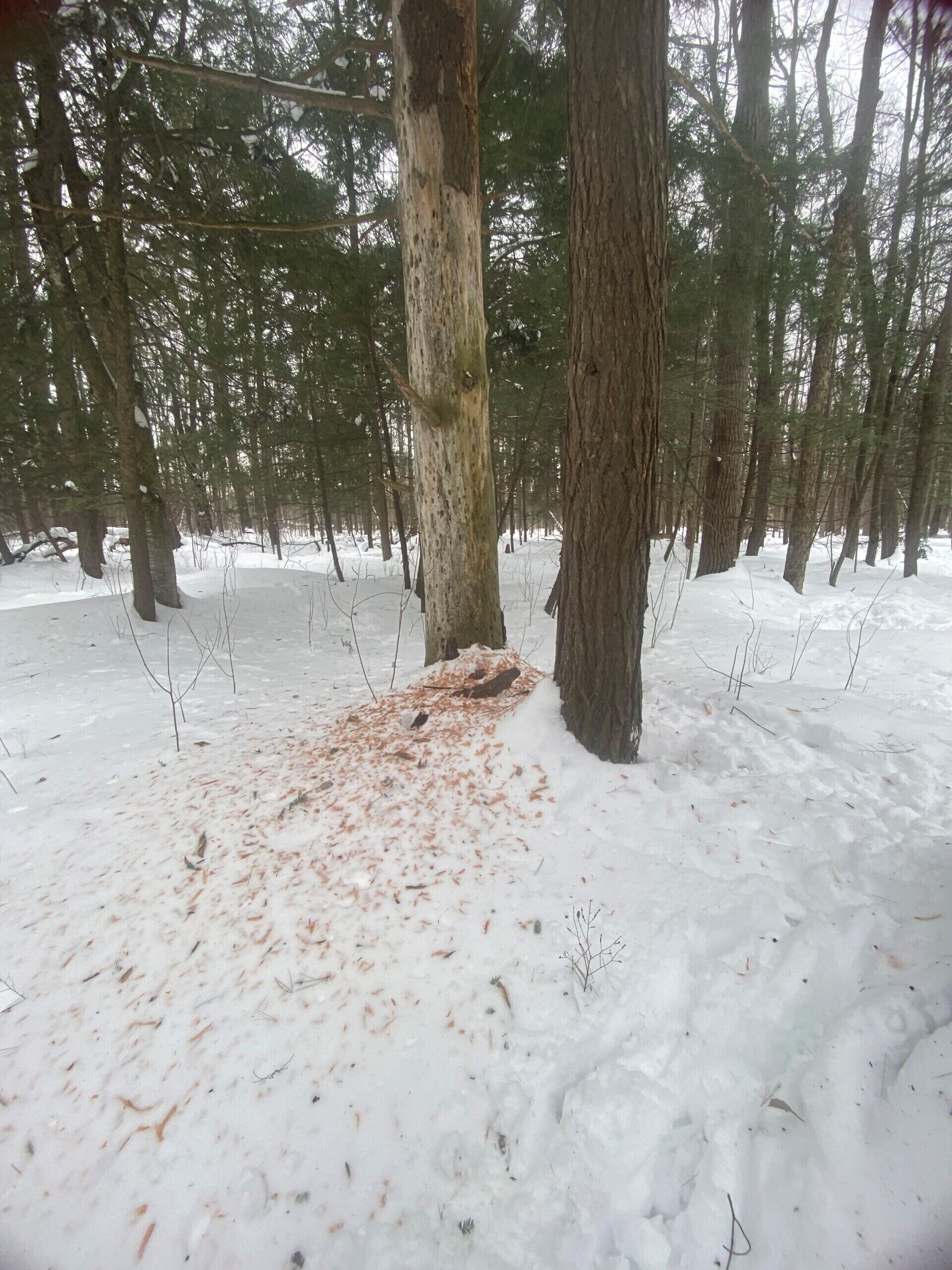
Pileated woodpecker (Dryocopus pileatus) damage to a tree.

Large feeding furrows made by a pileated woodpecker (Dryocopus pileatus).
Selected references
Aubrey, K.B.; Raley, C.M. 2002. The pileated woodpecker as a keystone habitat modifier in the Pacific Northwest. Pages 257–274 in Proceedings of the symposium on the ecology and management of dead wood in western forests. W.F. Laudenslayer, Jr.; P.J. Shea; B.E. Valentine; C.P. Weatherspoon; T.E. Lisle, (technical coordinators). United States Department of Agriculture Forest Service, Pacific Southwest Research Station. Albany, California. General Technical Report PSW-GTR-181.
Barry, A.M.; Hagar, J.C.; Rivers, J.W. 2018. Use of created snags by cavity-nesting birds across 25 years. Journal of Wildlife Management 82(7): 1376–1384. https://doi.org/10.1002/jwmg.21489
Cornell Lab All About Birds. 2025. Pileated woodpecker. Cornell Lab of Ornithology. Ithaca, New York. Available at: https://www.allaboutbirds.org/guide/Pileated_Woodpecker [Accessed January 2025]
Environment and Climate Change Canada. 2023. Pileated woodpecker cavity identification guide. Available at: https://www.canada.ca/en/environment-climate-change/services/avoiding-harm-migratory-birds/pileated-woodpecker-cavity-identification-guide.html [Accessed March 2024]
Jackson, J.A.; Jackson, B.J.S. 2004. Ecological relationships between fungi and woodpecker cavity sites. The Condor 106(1): 37–49. https://doi.org/10.1093/condor/106.1.37
Parks, C.G.; Raley, C.M.; Aubry, K.B.; Gilbertson, R.L. 1997. Wood decay associated with pileated woodpecker roosts in western redcedar. Plant Disease 81(5): 551. https://doi.org/10.1094/PDIS.1997.81.5.551C
Cite this fact sheet
Callan, B.E. 2025. Pileated woodpecker damage. In J.P. Brandt, B.I. Daigle, J.-L. St-Germain, A.C. Skinner, B.C. Callan, and V.G. Nealis, editors. Trees, insects, mites, and diseases of Canada’s forests. Natural Resources Canada, Canadian Forest Service, Headquarters. Ottawa, Ontario.Page details
- Date modified: